


David (Young David) - 20250415
Once again, I made another digital artwork. But this time, it wasn’t just any random painting of a made-up character from my imagination. No, this one was special. This was a fan art, and not just any fan art either—it was of someone very real, someone from ancient times, someone who lived, fought, sang, wrote, and led. Someone whose name appears hundreds of times in the Bible. A boy who became a king. A shepherd who became a warrior. A poet who became a prophet. Yes—this was David.The design of this art was inspired by the upcoming CGI film "The David Movie", which many people are already looking forward to. I based my work closely on the look from its prequel miniseries "Young David", which was released last year. The series gave a fresh new style to David’s story while still keeping true to the heart of the Bible’s message. The young boy they showed—brave yet humble, curious yet faithful—touched me. So, I decided to honour that version and bring it to life in my art style.
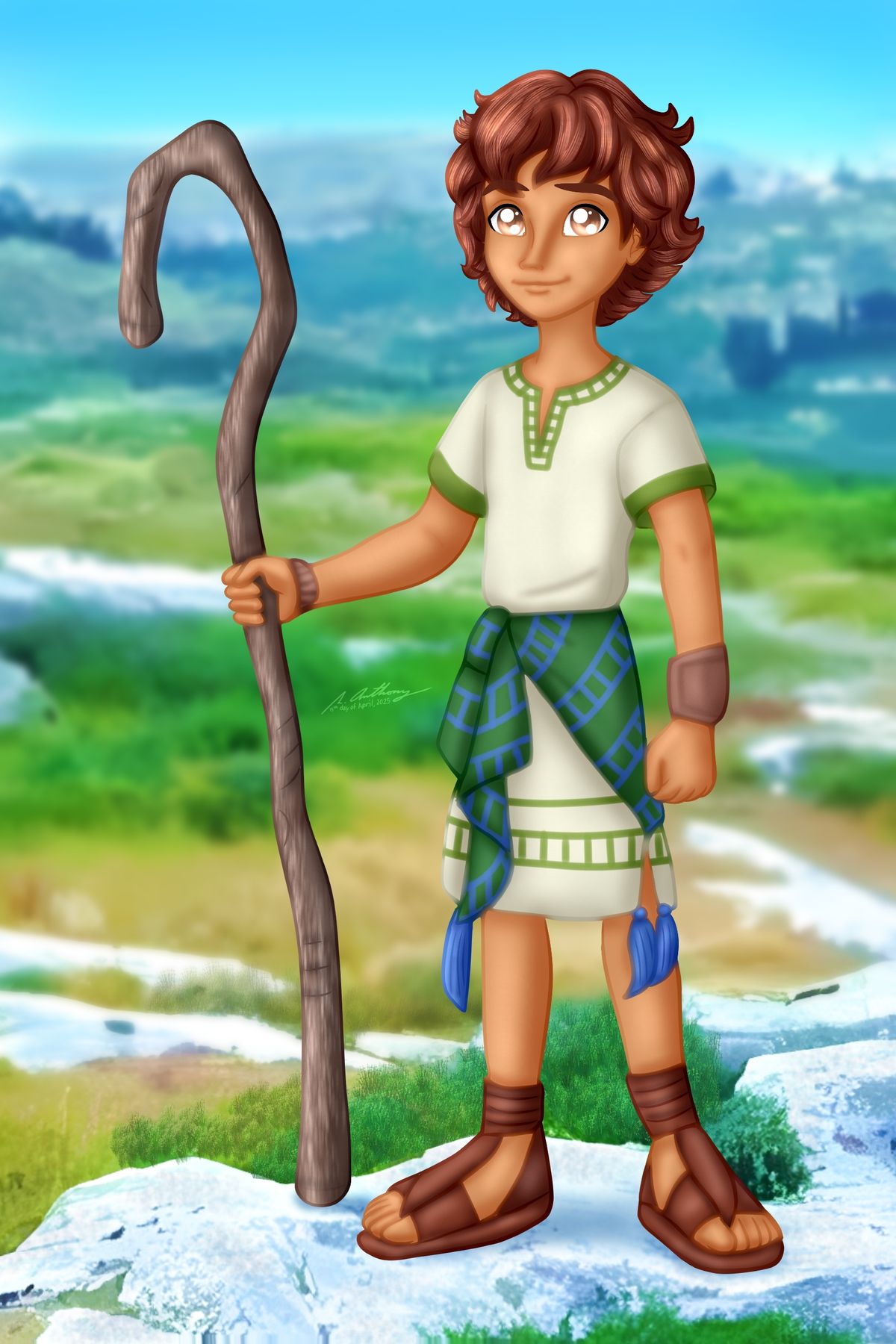
In my digital drawing, David is shown standing tall and calm, gazing into the distance. He’s holding a shepherd’s staff made of rough wood, curving naturally at the top, a symbol of both care and readiness to defend. His skin is a warm brown, sun-kissed from long days spent outdoors under the open skies of Bethlehem. His hair is tousled and curly, dark auburn with a touch of copper (perhaps the reason why he is described as "ruddy"), the kind of wild curls that bounce when he moves. His large eyes are gentle yet sharp—eyes that have seen danger in the wild and beauty in the stars above. Eyes that speak of courage and wonder.
He wears a simple tunic, cream in colour with green hems, stitched in a geometric pattern. The sleeves are short and practical, and the neckline is square with an open slit. Around his waist is tied a blue-and-green sash that falls on one side. The ends of the tunic are decorated with blue tassels, which bounce softly with every movement, a reminder of his Hebrew heritage and tribal roots. His arms show just a bit of strength, not yet grown into full muscle but the arms of a boy who works hard. On his right wrist is a leather cuff—perhaps a gift from his father or just something to protect him while herding sheep. On his feet are worn brown sandals, thickly strapped and tightly bound, made for walking across rocky ground and climbing steep hills.
David stands on a hilltop. Behind him stretches the green rolling fields of Bethlehem, and in the far distance, the hazy outlines of towns and valleys. The wind tousles his hair, causing him to squint against the sun as he gazes out at the landscape before him. Despite his youth, there is a sense of determination in his stance, a readiness to face whatever challenges may come his way. The skies above are blue and clear, open and full of promise. David takes a deep breath, feeling a surge of confidence as he prepares to embark on his journey.
But who was this David? Why would I choose to draw him? David is one of the most famous people in the Hebrew Scriptures, also known as the Old Testament. He was not just a king. He was a shepherd, a musician, a poet, a prophet, a warrior, and even a statesman. It’s hard to believe that one man could be all those things in one lifetime—but he was. What makes David so interesting is not just the things he did but the kind of person he was. He wasn’t perfect, not by any means. He made big mistakes—some of them very serious. But he always admitted his wrongs, prayed with a broken heart, and returned to God. That’s what makes him stand out. He was strong but also soft. Brave, but also full of feeling.
David’s roots trace back to a beautiful story of love and loyalty. He was the great-grandson of Ruth and Boaz—a Moabite woman and an Israelite man whose romance is told in the Book of Ruth. Through Boaz, David came from the line of Judah, the same tribe from which the Messiah—Jesus—would later come. Jesse, David’s father, had eight sons. David was the youngest. The forgotten one. The one was left out in the fields while the rest were called forward.
When God told the prophet Samuel to go to Jesse’s house and anoint the next king, Samuel looked at the older brothers one by one. Strong, tall, handsome—but none of them were chosen by God. “Jehovah has not chosen these,” Samuel said. Then Jesse remembered the youngest one, still out watching the sheep. They called David in. And when he came, Scripture tells us he was “ruddy,” meaning with a healthy, reddish glow maybe in his hair, “with beautiful eyes and a fine appearance.” And right there, in front of his surprised family, God told Samuel, “Get up, anoint him, for this is the one!”
That moment changed everything. I often wonder how David felt that day. Did he feel nervous, standing there while the prophet poured oil on his head? Did he understand what it meant? Or was he just happy to be included for once after being left out? But God saw what no one else saw. And you know what? That part touched me. Because sometimes, in our own lives, we feel unnoticed. We feel small. We feel like others are better, stronger, and more talented. But David’s story reminds us that God doesn’t look at outward things. He looks at the heart.
David’s days as a shepherd shaped him deeply. Out in the fields, he learned how to care for sheep, how to guide them, feed them, and protect them. He learned how to fight wild animals with his bare hands—he once killed a lion and a bear to save a sheep. He also learned how to be still, how to sing, how to play the harp, and how to write poetry. He probably spent hours watching the clouds, the stars, the flow of water, the flight of birds. All these things helped shape his music and his prayers. He would later write Psalm 8, “When I consider your heavens, the work of your fingers…” and Psalm 23, “YHWH is my Shepherd…” That’s not just poetry—it’s real experience.
Later in life, David became famous for slaying the giant Goliath. But what gave him the courage to fight that enormous warrior with just a sling and five stones? It wasn’t pride. It was faith. He remembered how God helped him defeat the lion and the bear. He trusted that God would help him again. And God did. David's faith was not just a belief in something abstract but a deep trust based on personal experiences of God's protection and provision. This faith gave him the courage to face any challenge, no matter how daunting.
But the road to kingship wasn’t quick. David didn’t become king the day he was anointed. He spent years being hunted by King Saul, who was jealous of him. David hid in caves, ran through deserts, and even pretended to be mad in enemy lands just to stay alive. Yet through all of that, he refused to harm Saul, even when he had the chance. That showed the depth of David’s heart. He trusted that if God had chosen him, God would put him on the throne at the right time. David waited. And waiting, as we all know, isn’t easy.
When David finally became king, he ruled with strength and care. He united the tribes, established Jerusalem as the capital, and made plans for the temple. But he also made big mistakes. The worst was his sin with Bathsheba and the murder of her husband, Uriah. When the prophet Nathan confronted him, David didn’t make excuses. He wept. He wrote Psalm 51, one of the most moving prayers of repentance ever written: “Create in me a clean heart, O God…”
That’s what makes David so relatable. He was real. Not a perfect superhero, but a man who deeply loved God and always came back to Him, no matter how far he fell. He was also very musical. David played the harp so well that when King Saul was troubled, he would call David to play, and it would calm him down. David also invented musical instruments and organised the singers and musicians for the temple. Many psalms are signed with his name. Seventy-three psalms for sure, and maybe more. They’re full of emotion—joy, sorrow, anger, hope. That’s why they still touch people today.
Even God Himself spoke highly of David, calling him “a man after my own heart.” That’s a deep thing to be called. David's legacy as a musician and songwriter continues to inspire people of faith and those who appreciate music. His ability to express a wide range of emotions through his psalms has made him an enduring figure in history. His influence can be seen in the way music is used in religious worship and how songwriters continue to draw inspiration from his work. David's impact on music and faith is truly timeless.
Looking at my painting of young David, I see more than just a character from a story. I see an example. Someone to admire. Someone who reminds me that even when life feels small or slow, even when I feel like a nobody, God can still be working behind the scenes, preparing me for something greater. David was once just a boy with a staff and a sling, walking with sheep and singing to the stars. But in time, he became a shepherd of people, a king who pointed forward to a greater King—Jesus Christ, who was called the “Son of David.”
I hope my art captures even just a piece of that. The warmth of the sunlight. The strength is in his quiet stance. The look in his eyes. I didn’t just want to draw a boy with a stick. I wanted to draw the beginning of something great. A future king. A poet of the Most High. A heart full of music and truth. I wanted to capture the essence of a young shepherd who would one day lead a nation with wisdom and courage. Through my art, I aim to convey the potential and promise that David embodied in his youth. And maybe, as I keep drawing and creating, I’ll remember that my own story is being written, too. One painting at a time.Apr 15, 2025
#david
#fanart
#digitalart
Comments
No comments yet